Can We Narrate a Story in Another Form?
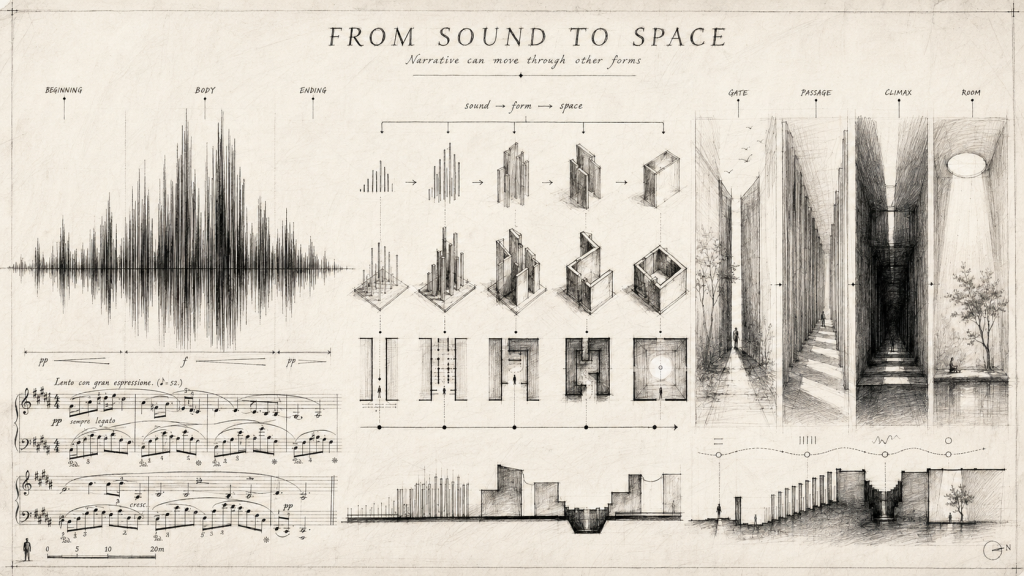
From words to music, film, and architecture
In my previous articles, I explored two connected ideas.
The first was that the built environment can act like a plot. A plot is not simply a sequence of events; it is the hidden structure that organizes tension, expectation, movement, and transformation. In architecture and urban design, this means that a building, a street, or a public space is not only a physical object. It can become a structure that prepares the possibility of events.
The second was the idea of the chronotope in narrative design. Borrowed from Mikhail Bakhtin, the chronotope helps us understand how time and space become inseparable in storytelling. A story does not happen in abstract time or empty space. It always happens somewhere, sometime, under specific emotional, cultural, and spatial conditions. This is where narrative becomes architectural.
This article continues that argument by asking a simple question:
Can we narrate a story in another form?
Not through written language.
Not through spoken explanation.
But through music, film, painting, movement, atmosphere, and finally, through space.
1. Story is not limited to words
When we hear the word “story,” we often imagine a book, a voice, or a script. But narrative theory allows us to expand this idea.
A story can be understood as a structure of events, emotions, characters, memory, conflict, transformation, and time. The medium may change, but the narrative force can remain.
Mark Childs, in Storytelling and Urban Design, argues that stories are not only written or spoken; they can be carried through music, painting, dance, and built form. He also reminds us that built form is a medium for cultural storytelling, although buildings do not operate like words. Buildings cast shadows, occupy land, shape movement, and create real physical situations. In that sense, urban design tells stories in its own way.
This is important because it moves storytelling away from literal explanation. A story does not always need to say, “this happened, then this happened.” Sometimes a story is felt before it is understood.
Music does this.
Film does this.
Ritual does this.
Landscape does this.
Architecture can also do this.
2. Music as narrative: Chopin’s Nocturne No. 20
Chopin’s Nocturne No. 20 in C-sharp minor, Op. posth., also known as Lento con gran espressione or “Reminiscence,” is a powerful example of a story told without words. It appears on the original soundtrack of The Pianist, performed by Janusz Olejniczak, as “Nocturne No. 20 in C-Sharp Minor.” (Apple Music Classical – Web Player)
The piece does not narrate through characters or dialogue. It narrates through tempo, silence, repetition, hesitation, tension, and release.
Its beginning feels like a gate.
The opening does not enter the listener violently. It opens slowly, almost like a door into memory. The first notes create a threshold condition: we are not yet inside the story, but we are being invited into it. It is fragile, quiet, and suspended.
Then the body of the music begins to move. The melody becomes a wandering voice. The accompaniment gives continuity, almost like footsteps, breathing, or time passing beneath the surface. The music does not describe a city, but it creates a psychological landscape: a space of memory, loss, longing, and survival.
The ending is not a heroic resolution. It is more like the survival of a small light. Something remains. The story does not fully close; it settles.
So even without words, the music produces a narrative structure:
| Musical moment | Narrative role | Spatial image |
| Opening | Threshold / entry | A gate, a dark doorway, a radio room |
| Main body | Journey / confrontation | A corridor, a ruined street, a hidden passage |
| Intensification | Conflict / emotional climax | Compression, danger, exposed space |
| Ending | Fragile resolution | A quiet chamber, a window of light |
The audience receives a story, even though no one has explained it verbally.
3. Film as narrative translation: The Pianist
When the same music enters The Pianist, the story becomes more specific.
The film gives the music a historical body: Warsaw, war, displacement, hiding, cultural identity, and survival. Music becomes attached to a character, a city, and a historical trauma. Chopin’s nocturne is no longer only an emotional composition; it becomes part of a cinematic chronotope.
This is what film does so powerfully. It combines music, image, body, time, editing, silence, and setting. The audience does not only listen; they witness.
In The Pianist, Chopin’s music is not background decoration. It becomes a narrative device. It tells us who Szpilman is before the film fully explains him. It carries his identity when almost everything else is taken away. It connects personal memory to collective history.
This is why the example is so useful for architecture: it shows that a story can migrate from one medium to another.
The same narrative energy can move:
from music → to film → to spatial imagination.
4. Chronotope as the linkage between story and form
Bakhtin’s chronotope gives us the theoretical bridge.
A chronotope is the meaningful fusion of time and space in a narrative. It is not just a setting. It is not just a timeline. It is the condition that allows the story to happen.
For example, a road in a novel is not only a road. It is a chronotope of encounter, departure, danger, and transformation. A threshold is not only an entrance. It is a chronotope of transition. A room is not only a container. It can be a chronotope of memory, intimacy, isolation, or revelation.
This is where Bakhtin becomes extremely useful for narrative design.
If every story needs a time-space condition, then every medium that can shape time and space can potentially carry narrative.
Music creates an emotional chronotope.
Film creates a cinematic chronotope.
Architecture can create a spatial chronotope.
In Chopin’s nocturne, the chronotope is not literal. It is emotional: night, memory, solitude, fragility, survival.
In The Pianist, the chronotope becomes historical and cinematic: wartime Warsaw, destroyed interiors, hiding spaces, radio rooms, ruins, and moments of human recognition.
In architecture, the same chronotope could become physical: a threshold, a compressed passage, a dark chamber, a framed view, a trace of material memory, a final open room.
So the chronotope is the linkage between story and form. It explains how narrative can move from one medium to another without needing to remain literal.
5. Can this be transferred to the built environment?
I think yes; but it becomes harder.
Music controls time. The composer controls tempo, duration, rhythm, repetition, silence, and climax. The listener enters the piece and moves through time according to the structure of the composition.
Film also controls time. The director controls sequence, camera angle, montage, sound, silence, and duration. Even when the story is nonlinear, the audience still receives the work through a controlled timeline.
Architecture is different.
In architecture and urban space, the designer does not fully control time. People move at different speeds. They enter from different directions. They stop, ignore, return, sit, rush, gather, photograph, or leave. Their story is not fixed by the designer.
This is the difficulty; but also the opportunity.
Architecture should not try to narrate like a film. It cannot completely control the audience’s timeline. Instead, it can guide, suggest, frame, slow down, intensify, reveal, hide, and invite.
Aminzadeh makes this connection directly in their work on landscape design and cinema. They argue that landscape can be understood as a network of spaces and events perceived through movement. Their study connects landscape design with scenario writing, using shared terms such as sequence, frame, event, turning point, climax, beginning, and end.
This is a crucial shift. Space does not need to tell one fixed story. It can create a narrative field where the visitor constructs a personal story through movement.
6. Architecture does not narrate by explaining; it narrates by staging
A written story tells.
A film shows.
Music moves.
Architecture stages.
Architecture narrates by creating conditions for experience.
It can use:
| Narrative element | Architectural translation |
| Beginning | Entrance, threshold, first view |
| Character | The moving body, the visitor, the community |
| Plot | Spatial sequence and decision-making |
| Conflict | Compression, obstruction, contrast, exposure |
| Memory | Material traces, ruins, fragments, inscriptions |
| Rhythm | Repetition of columns, openings, light, sound, steps |
| Silence | Void, pause, courtyard, dark room, empty surface |
| Climax | Reveal, height, light, view, gathering point |
| Resolution | Resting place, open horizon, return, reflection |
This means the architect is not exactly an author in the traditional sense. The architect is closer to a stage director, a composer of conditions, or a designer of chronotopes.
Pizarro’s work on the urban sensorium supports this idea. He argues that urban experience is not only visual; it includes sound, temperature, humidity, smell, bodily fatigue, emotion, and psychological response. His studio method used flânerie, audio-video recording, cinematic storyboarding, and “a day in the life” films to help designers understand the sensory relationship between people and the built environment.
This is exactly where narrative design becomes architectural. The story is not only what people see. It is what the body experiences through time.
7. The built environment as an open story
The most important difference between architecture and film is openness.
A film usually has a fixed beginning and ending.
A piece of music has a controlled duration.
A painting has a fixed frame.
But a public space is open-ended.
People enter it from many directions. They bring their own memories. They use it at different times of day, in different seasons, alone or with others. They may create events that the architect never predicted.
So the goal is not to force a single master narrative onto the space.
The goal is to create a structure that supports many possible stories.
Childs argues that urban designers should avoid relying only on master narratives and should instead support diverse, independent stories within the public realm. He describes storytelling as part of urban design and suggests that designers can listen to the narrative fabric of place, curate stories, and create settings for everyday stories, myths, and collective meanings.
This is very close to the idea of a Generative Narrative Field: a spatial system that does not simply represent a story, but allows stories to happen.
Architecture, then, becomes less like a completed sentence and more like a grammar.
It gives people spatial words: gate, path, room, edge, frame, shadow, light, pause, height, sound, material, trace.
But the visitor composes the sentence.
8. Returning to Chopin: what can architecture learn from music?
Chopin’s nocturne teaches us that a story can be powerful without being literal.
It does not need text to create a beginning.
It does not need dialogue to create emotion.
It does not need image to create space.
It does not need a visible character to create presence.
The music works because it organizes experience through rhythm, tension, silence, and return.
Architecture can learn from this.
A building or public space can also create a beginning like a gate. It can create a body through movement. It can create tension through compression and uncertainty. It can create memory through material. It can create resolution through light, openness, or stillness.
But architecture must accept that the visitor is not a passive audience. The visitor is both reader and character.
In space, people do not only receive the story.
They perform it.
9. So, can we tell a story through space?
Yes — but not in the same way that a novel, film, or musical composition does.
Architecture cannot fully control narrative time. It cannot guarantee that every visitor follows the same sequence or feels the same emotion. But it can create spatial chronotopes: meaningful time-space conditions where memory, movement, event, and emotion become possible.
This may be the true power of narrative design in architecture.
Not to illustrate a story.
Not to decorate a building with symbols.
Not to turn space into a literal script.
But to design places where stories can be generated, remembered, and retold.
The built environment becomes narrative when it shapes the relationship between:
place + time + body + memory + event.
That is where architecture begins to speak.
Not as text.
Not as voice.
But as experience.
Core academic references
Childs, M. C. (2008). Storytelling and urban design. Journal of Urbanism: International Research on Placemaking and Urban Sustainability, 1(2), 173–186. Use for: storytelling beyond written/spoken language, built form as cultural storytelling, narrative landscapes.
Aminzadeh, B., Motevali, M., & Nikooparast, S. (2015). A proposal for landscape design process based on scenario writing phases in cinema and its application in the Darabad route, Tehran, Iran. URBAN DESIGN International. Use for: movement, sequence, frame, event, turning point, climax, and the relationship between cinema and landscape design.
Pizarro, R. E. (2009). Teaching to understand the urban sensorium in the digital age: Lessons from the studio. Design Studies, 30(3), 272–286. Use for: urban sensorium, cinematic storyboarding, flânerie, sensory experience, and the relationship between body and built environment.
Swanson, L. T. (2011). Directed landscapes: History and theater in contemporary landscape architecture. Studies in the History of Gardens & Designed Landscapes, 31(4), 286–293. Use for: landscape as theatre, historical imagination, traces of the past, and landscape as a stage for memory.
Taylor, N. (1999). The elements of townscape and the art of urban design. Journal of Urban Design, 4(2), 195–209. Use for: urban design as an applied art, townscape elements, and the sensory/aesthetic materials of urban space.
Soliva, R., & Hunziker, M. (2009). Beyond the visual dimension: Using ideal type narratives to analyse people’s assessments of landscape scenarios. Land Use Policy, 26(2), 284–294. Use for: visual and non-visual dimensions of landscape perception, values, assumptions, memory, and stakeholder interpretation.
Viña, S., & Mattelmäki, T. (2010). Spicing up public journeys: Storytelling as a design strategy. ServDes.2010 ExChanging Knowledge. Use for: storytelling in customer journeys, public service environments, urban experience, and emotional/experiential design.
Reliable supporting references for Chopin / The Pianist
Ross, A. (2022). Chopin’s Nocturnes Are Arias for the Piano. The New Yorker. Use for: musical interpretation of Chopin’s nocturnes, including expressive structure and emotional reading of the C-sharp-minor nocturne. (The New Yorker)
Denby, D. (2003). Nocturnes. The New Yorker. Use for: critical discussion of The Pianist, Holocaust representation, Szpilman, and the role of music in the film’s emotional world. (The New Yorker)
Boosey & Hawkes. Władysław Szpilman: The Pianist Series. Use for: reliable biographical background on Szpilman, including the association between Chopin’s Nocturne in C-sharp minor and the 1939 Polish Radio broadcast. (boosey.com)
Optional theoretical foundation
Bakhtin, M. M. (1981). Forms of time and of the chronotope in the novel. In The Dialogic Imagination: Four Essays.