City as Narrative
Plot, Chronotope, and the Built Environment
Introduction
Cities are often described through infrastructure, density, economics, zoning, and form. Yet none of these alone explains why certain places become alive while others remain emotionally empty. A successful city is not merely a composition of buildings and streets; it is a field of events, memories, meanings, and human interactions unfolding through time.
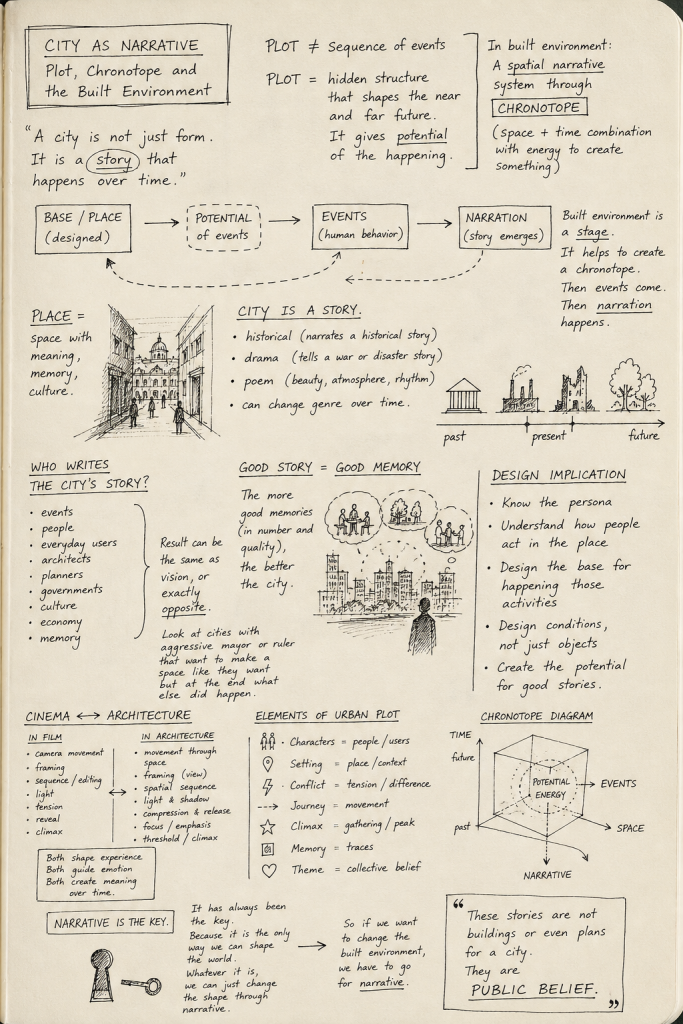
The relationship between storytelling and the built environment reveals a deeper structure behind both disciplines. A story is not only a sequence of events, just as architecture is not only an arrangement of objects in space. Both are organized through an underlying narrative framework; a plot.
However, plot should not be understood as chronology or simple order. Plot is a hidden structure of potentiality. It creates the conditions for events to emerge. It organizes relationships between actors, movement, memory, tension, and transformation across time. In literature and cinema, plot shapes narrative experience. In architecture and urbanism, plot shapes human experience within the built environment.
This suggests that cities themselves can be understood as narrative systems.
Plot as Potential
In conventional understanding, plot is often reduced to the order of events. Yet in narrative theory, plot is more than sequence. It is the invisible structure that generates meaning and guides transformation.
Similarly, urban environments are not neutral containers. Streets, plazas, buildings, edges, thresholds, and routes establish latent possibilities for human behavior. Architecture does not directly produce events, but it constructs the potential for events to happen.
This relationship can be understood through the concept of the chronotope — the fusion of space and time into a meaningful experiential condition. Certain environments possess an intensity that encourages gathering, encounter, protest, celebration, intimacy, conflict, or memory. The physical setting alone is insufficient; what matters is the interaction between spatial conditions and temporal occupation.
A narrow alley at night, a civic square during protest, a waterfront at sunset, or a stadium concourse before a match all operate as chronotopes. They are not simply spaces. They are narrative conditions charged with potential energy.
Architecture therefore becomes less about object-making and more about constructing the framework for future stories.
Architecture and Cinema
The relationship between architecture and cinema reveals how spatial experience itself can become narrative.
In film, directors use framing, movement, sequencing, light, compression, and reveal to shape emotional experience. The camera guides perception through carefully constructed spatial relationships. Architecture can operate similarly.
A corridor can build tension before opening into a public square. A framed view toward mountains or water can create anticipation and orientation. A change in elevation can produce drama. A compressed entrance can amplify the emotional release of entering a cathedral, stadium, or civic hall.
Urban movement resembles cinematic editing. The pedestrian experiences the city sequentially rather than all at once. Streets become transitions between scenes. Intersections become moments of decision. Landmarks operate as narrative anchors.
The city is therefore not experienced as a static object but as a temporal montage.
Architecture, like cinema, choreographs attention.
Place, Memory, and Meaning
Space becomes place when memory, meaning, and culture are attached to it.
A city is not only physical infrastructure; it is a collective archive of human experience. Historical districts narrate political histories. Memorials narrate trauma. Public squares narrate civic identity. Waterfronts narrate trade, migration, and industry. Even ordinary streets accumulate emotional narratives through everyday repetition.
Cities can therefore possess genres.
Some cities operate like historical epics, carrying visible layers of civilization across centuries. Others resemble dramas shaped by conflict, reconstruction, or political tension. Some urban environments become poetic — structured less through monumentality and more through atmosphere, rhythm, and intimacy.
Importantly, urban genres can change over time. Industrial districts become cultural quarters. Spaces of conflict become spaces of reconciliation. Places of exclusion become places of gathering.
The city continuously rewrites itself through collective narration.
Narrative and Human Behavior
Architects and planners do not directly design behavior. They design conditions of possibility.
Every master plan, street network, public plaza, transit hub, or housing block contains assumptions about future life. Yet urban narratives are never fully controlled. Human events may reinforce the intended narrative or completely overturn it.
History repeatedly demonstrates this tension. Authoritarian regimes often attempt to impose ideological narratives through monumental urbanism, rigid order, and symbolic control. Yet citizens reinterpret, resist, occupy, and transform these spaces through everyday use.
This reveals an important distinction:
the true author of the city is not the architect alone, but the event itself.
Urban narrative emerges from the interaction between designed intention and lived occupation.
The Good City as Collective Memory
If cities are narrative systems, then the quality of urban life may be measured through memory.
A successful built environment is not necessarily the tallest, densest, or most efficient. It is the environment capable of generating meaningful experiences that remain in collective memory.
The value of a city may therefore depend on:
- the quantity of meaningful encounters,
- the intensity of shared experiences,
- the diversity of narratives,
- and the continuity of emotional memory.
Great urban spaces become unforgettable because they support human stories.
In this sense, architecture is not simply construction. It is memory-making.
Narrative as the Foundation of Urban Transformation
Narrative has always shaped human reality. Political systems, religions, nations, economies, and identities all emerge through shared stories. The built environment is no exception.
Urban transformation cannot occur through form alone. Buildings without narrative become isolated objects. Planning without narrative becomes technical administration. Infrastructure without narrative becomes emotionally invisible.
To reshape cities, society must first reshape collective narratives about how life should be lived together.
The future city is therefore not merely a physical project. It is a public belief.
Architecture does not only construct buildings; it constructs frameworks through which societies imagine themselves.
Conclusion
The relationship between storytelling and architecture is not metaphorical. Both disciplines organize human experience through narrative structures operating across space and time.
Plot, understood as a latent structure of potentiality, becomes central to both. In literature and film, plot organizes emotional and temporal experience. In architecture and urbanism, plot organizes movement, encounter, memory, and event.
Cities are therefore not static compositions of objects. They are living narrative systems continuously rewritten through occupation, memory, and collective belief.
The task of architecture is not merely to produce form, but to create the conditions for meaningful stories to emerge.