What is Exactly Chronotope in Narrative Design
Chronotope and Narrative Design
Architecture as a Condition for Human Stories
In my previous article, I explored the idea that the built environment can operate like a narrative system.
Architecture is not only form, function, image, or technical performance. It also shapes memory, movement, emotion, encounter, and collective meaning. In that sense, architecture can work in a similar way to literature or cinema. It does not necessarily “tell” a story directly, but it can create the conditions in which stories become possible.
This second part develops that idea through the concept of the chronotope.
Abstract
The word chronotope comes from literary theory, particularly from Mikhail Bakhtin’s essay Forms of Time and of the Chronotope in the Novel, published in The Dialogic Imagination.
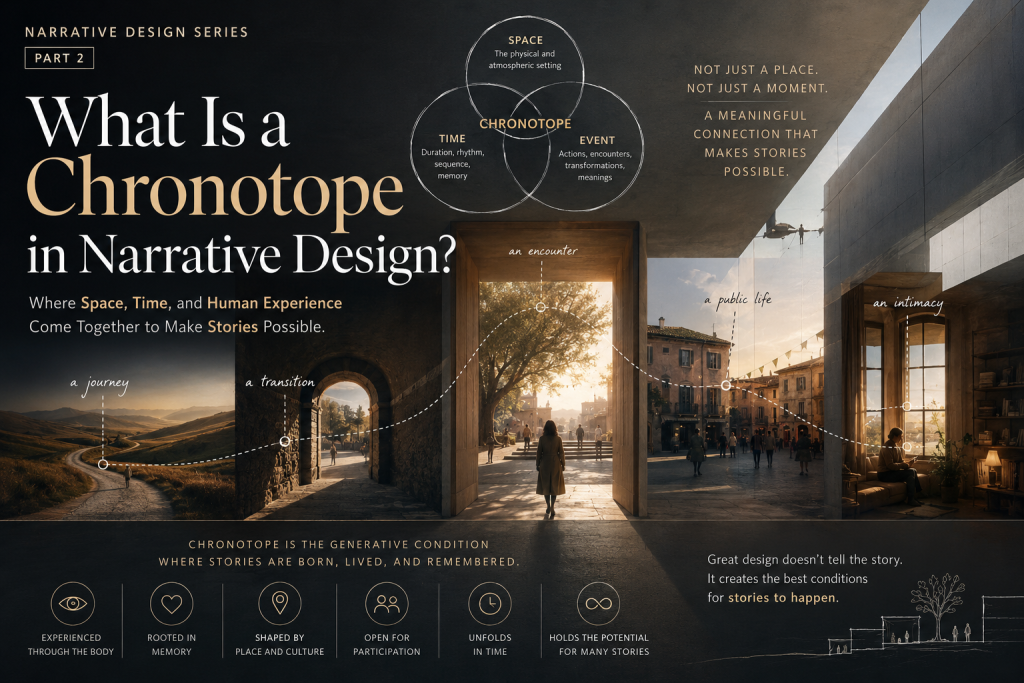
In simple terms, a chronotope is the meaningful connection between space, time, and event.
In storytelling, space is never neutral. A road, a threshold, a castle, a town square, or a room each creates a different kind of story. A road creates encounter. A threshold creates transition. A castle carries memory and history. A square produces public drama. A room allows intimacy and dialogue.
I believe this idea can be translated into architecture and urban design.
A chronotope in the built environment is not just a symbolic space or a place with a story attached to it. It is a spatial-temporal condition where movement, atmosphere, memory, identity, and human interaction come together strongly enough to make meaningful events possible.
This article brings together Mikhail Bakhtin, Christopher Alexander, Juhani Pallasmaa, Gaston Bachelard, and Christian Norberg-Schulz to ask one central question:
How can architecture create deeper experiences and more powerful human stories?
1. We Are Storytellers Before We Are Designers
Human beings understand the world through stories.
We connect events.
We remember places.
We give meaning to our lives through moments, relationships, rituals, and memories.
A childhood street, a school corridor, a public square, a window seat, a garden path, or a corner café can become meaningful because something happened there. The meaning of a place is rarely only in its physical form. It is also in the events, memories, and emotions that the form makes possible.
This is why I think architecture should not only ask:
What does this space look like?
How does it function?
How efficient is it?
It should also ask:
What kinds of moments can happen here?
What kinds of memories can be formed here?
What kinds of relationships can this space support?
What kinds of stories can this place hold over time?
This is where the concept of chronotope becomes useful.
2. What Is a Chronotope?
For Bakhtin, the chronotope is the way time and space are fused together in a story.
A story does not happen in abstract space. It needs a specific kind of world. The type of space changes the type of event. The type of time changes the emotional meaning of the story.
For example:
The road is a chronotope of movement, accident, encounter, and transformation. People meet each other because they are moving through the same path.
The threshold is a chronotope of decision, transition, and change. It is the moment between one condition and another.
The castle is a chronotope of memory, power, inheritance, secrecy, and history.
The town square is a chronotope of public life, ceremony, politics, celebration, and conflict.
The salon or room is a chronotope of conversation, intimacy, identity, and social exchange.
These are not just “settings.” They are event-making structures.
This distinction is important for architecture.
A space is not just a container for activity. A space can increase or decrease the possibility of certain events. A bench under a tree, a stair facing a plaza, a narrow passage opening into a courtyard, or a café at the edge of a street can all become spatial situations where human stories begin.
3. From Storytelling to Architecture
In architecture, the chronotope can help us move away from a limited idea of “storytelling.”
Storytelling in architecture is often understood as adding symbols, graphics, murals, historical references, or themed design elements. These can be valuable, but they are not enough.
A deeper form of narrative design is not about forcing one fixed story onto a building or public space.
It is about creating the best conditions for many stories to happen.
The architect is not the only storyteller. Users, residents, visitors, children, workers, and communities also become storytellers through their daily use of space.
In this sense, a meaningful built environment is not one that tells one perfect story. It is one that can host, generate, absorb, and retell many stories over time.
This connects directly to an idea I explored in my thesis: the narrative/social womb.
By this, I mean the generative condition from which stories are born in public space. Before a story exists, there must be a situation that allows it to happen. There must be a relationship between people, place, memory, time, and meaning.
A public realm becomes powerful when it can act as this kind of generative condition.
It becomes a place where collective life can appear, where events can be remembered, and where people can recognize themselves as part of a larger story.
4. Christopher Alexander: Patterns That Make Life Possible
Christopher Alexander is important to this discussion because his work is not only about form. It is about life.
In The Timeless Way of Building and A Pattern Language, Alexander describes recurring spatial patterns that support human life. He was interested in why some places feel alive, comfortable, natural, and meaningful, while others feel empty or disconnected.
His famous idea of the “quality without a name” refers to the deep sense of life that some places have. It is difficult to define, but we recognize it when we experience it.
Alexander’s patterns can be understood as architectural chronotopes.
An entrance transition is not only a doorway. It is a moment of psychological change from outside to inside.
A courtyard is not only an open space. It can be a place of gathering, repetition, memory, and collective life.
A window place is not only an opening in a wall. It can become a moment of pause, observation, imagination, and solitude.
A street café is not only a commercial function. It is a social edge where people watch, meet, wait, and become part of public life.
A staircase is not only circulation. It can become a stage, a place of movement, visibility, encounter, and performance.
This is the value of Alexander’s work for narrative design: he shows that good architecture is made of recurring human situations, not only abstract forms.
His patterns are not stories by themselves. They are conditions that make stories more likely.
5. Juhani Pallasmaa: Stories Are Felt Through the Body
Juhani Pallasmaa adds another essential layer.
In The Eyes of the Skin, Pallasmaa argues that architecture has become too dominated by vision. We often design for images, renderings, façades, and visual impact, while forgetting that architecture is experienced through the whole body.
A powerful space is not only seen.
It is heard.
It is touched.
It is smelled.
It is felt through temperature, material, sound, shadow, scale, and movement.
This is very important for chronotope in architecture.
A chronotope cannot be only visual. It must be embodied.
Think about the difference between seeing a beautiful plaza in a rendering and actually standing there on a windy day. Think about the sound of footsteps in a passage, the smell of rain on stone, the warmth of wood, the echo of a lobby, the shadow of a tree, or the feeling of compression before entering a larger space.
These sensory experiences give depth to memory.
A space becomes narratively powerful when the body remembers it.
So, if we want to create stronger stories in architecture, we must design stronger sensory experiences.
6. Gaston Bachelard: Memory, Imagination, and Intimate Space
Gaston Bachelard, in The Poetics of Space, helps us understand the intimate side of chronotope.
He writes about houses, rooms, corners, stairs, drawers, nests, attics, cellars, and windows. These are small spaces, but emotionally they can become very large.
For Bachelard, space is not only physical. It is poetic. It holds memory and imagination.
A corner can become a place of retreat.
A window can become a place of dreaming.
A stair can hold years of repetition.
A childhood room can become part of a person’s inner world.
This is important because not all architectural chronotopes are public or monumental. Some are quiet, personal, and intimate.
A powerful story does not always need a dramatic public event. Sometimes it begins with a small moment: sitting by a window, waiting on a stair, entering a familiar room, or returning to a place after many years.
Bachelard reminds us that architecture becomes meaningful when it gives space for imagination.
A good space is not only used. It is inhabited emotionally.
7. Christian Norberg-Schulz: Place, Identity, and Belonging
Christian Norberg-Schulz brings the discussion to the idea of place.
In Genius Loci: Towards a Phenomenology of Architecture, he argues that architecture should help people dwell meaningfully in the world. The Latin term genius loci means the spirit of place.
For Norberg-Schulz, place is not just a location. It is a meaningful whole made of landscape, atmosphere, culture, memory, orientation, and identity.
This is directly connected to chronotope.
A strong chronotope is not only eventful. It is placeful.
It helps people understand where they are. It gives orientation. It gives atmosphere. It allows people to feel that they belong to a specific place, not just to a generic environment.
This is especially important today, when many urban spaces are becoming visually similar. Many places function well, but they do not stay in memory. They do not feel rooted. They do not express the specific life of their context.
Norberg-Schulz helps us understand that meaningful architecture must connect event with place identity.
A story becomes deeper when it could not happen in exactly the same way anywhere else.
8. Bringing the Theories Together
Each of these thinkers gives one part of the framework.
Bakhtin teaches us that stories need a strong relationship between space, time, and event.
Alexander teaches us that living places are made from recurring human patterns.
Pallasmaa teaches us that architecture must be experienced through the body and senses.
Bachelard teaches us that spaces hold memory and imagination.
Norberg-Schulz teaches us that place gives identity, orientation, and belonging.
Together, they help define a new understanding of narrative design in architecture.
Narrative design is not the design of a fixed story.
It is the design of spatial-temporal conditions where meaningful stories can emerge.
This is the architectural chronotope.
9. A New Definition of Chronotope in Architecture
I would define an architectural chronotope as:
A spatial-temporal condition where place, movement, atmosphere, memory, identity, and human interaction become connected strongly enough to make meaningful events possible, memorable, and repeatable.
Or more simply:
A chronotope in architecture is a place where space and time become charged with the potential for human stories.
This definition is important because it shifts the role of architecture.
Architecture is not only about producing objects.
It is not only about solving programs.
It is not only about creating images.
Architecture can create the conditions for life to become meaningful.
10. How Does an Architectural Chronotope Work?
An architectural chronotope works through several connected mechanisms.
1. It creates a situation
A strong chronotope invites something to happen.
For example, a stair facing a public space can become a place to sit, watch, wait, perform, protest, or meet.
The architect does not control the story, but the design increases the possibility of stories.
2. It connects movement to meaning
Movement is one of the strongest narrative tools in architecture.
A path can create anticipation.
A turn can create surprise.
A threshold can create transition.
A framed view can create revelation.
A sequence of spaces can create emotional rhythm.
This is why architecture is close to cinema. Both are experienced through time.
3. It intensifies the senses
A weak space is often only seen.
A strong space is felt.
Sound, shadow, texture, smell, temperature, light, and material can all make a place more memorable.
4. It holds memory
Chronotopes collect time.
A place becomes deeper when it can hold traces of previous events, visible layers of history, rituals, repeated uses, and collective memory.
Memory should not only appear as a plaque. It can be embedded in materials, alignments, reused structures, names, surfaces, and rituals.
5. It allows participation
A good architectural story should not be closed.
If a space is too controlled, people cannot add their own lives to it. But if a space allows adaptation, informal use, and interpretation, people become co-authors of the place.
This is essential for public space.
6. It connects the personal and the collective
A strong place allows individual memories and collective meanings to overlap.
A square can be a shortcut, a protest ground, a festival space, a meeting point, a childhood memory, and a civic symbol at the same time.
This multiplicity is what makes urban space narratively rich.
11. What Is a “Good Story” in Architecture?
In the built environment, a good story is not necessarily dramatic.
It does not need to be heroic, monumental, or symbolic.
A good story in architecture is an experience that becomes meaningful enough to be remembered, shared, repeated, or transformed into attachment.
It may involve:
encounter,
belonging,
discovery,
transition,
ritual,
memory,
conflict,
care,
loss,
joy,
or transformation.
A good story is not something the architect writes completely.
It is something people live.
The role of the designer is to create the best possible conditions for these lived stories to happen.
12. How Can We Create More Powerful Spaces for Good Stories?
If stronger stories need stronger chronotopes, then the design question becomes:
How do we create more powerful chronotopes?
Here are some possible principles.
Design stronger thresholds
Thresholds are moments of change.
They can be doors, gates, bridges, stairs, ramps, passages, lobbies, or changes in light and material.
A good threshold prepares people emotionally. It marks the movement from one condition to another.
Design sequences, not only objects
A building or public space should not be understood only as a static object.
It should be experienced as a sequence: approach, arrival, pause, movement, discovery, and return.
This makes architectural experience closer to narrative structure.
Create spaces for encounter
Stories often begin when people meet.
Shared paths, active edges, visible stairs, courtyards, cafés, transit nodes, and public seating can all increase the chance of encounter.
Give space for pause
Not every space should push people to move.
Good stories need moments of pause: places to sit, wait, observe, reflect, and belong.
Work with memory
Design should not erase all previous layers.
Traces, reused materials, old alignments, historic fragments, cultural references, and everyday memories can all help a place hold time.
Design for the whole body
Light is important, but so are sound, texture, temperature, smell, scale, and material.
The more deeply the body experiences a space, the more strongly the memory can form.
Allow ambiguity
Not every space should be over-programmed.
Ambiguity gives people room to interpret, adapt, and participate.
A space that allows different readings can hold more stories.
Connect to the spirit of place
A powerful space should feel specific.
It should respond to its climate, culture, history, landscape, community, and everyday life.
Generic space produces weak stories. Specific place produces deeper attachment.
13. Conclusion: Architecture as Story Potential
Architecture does not need to tell one fixed story.
It can do something more important.
It can create the best conditions for stories to begin, unfold, be remembered, and be retold.
This is why the concept of chronotope is valuable for architectural and urban design. It gives us a way to think about space and time together, not as abstract concepts, but as the foundation of human experience.
A road, a stair, a threshold, a courtyard, a window, a plaza, or a room can become more than a physical element. It can become a charged situation where life gains meaning.
For me, this is the core of narrative design:
Good architecture does not simply represent stories.
It creates chronotopes — spatial and temporal situations where meaningful stories can happen.
Architecture becomes powerful when it does not only solve needs, but also deepens human experience.
Further Reading
For chronotope and storytelling
Mikhail Bakhtin — The Dialogic Imagination, especially “Forms of Time and of the Chronotope in the Novel”
For living patterns and human events
Christopher Alexander — The Timeless Way of Building
Christopher Alexander, Sara Ishikawa, and Murray Silverstein — A Pattern Language
Christopher Alexander — The Nature of Order
For sensory and embodied architecture
Juhani Pallasmaa — The Eyes of the Skin: Architecture and the Senses
Juhani Pallasmaa — The Embodied Image
For poetic memory and intimate space
Gaston Bachelard — The Poetics of Space
For place, identity, and belonging
Christian Norberg-Schulz — Genius Loci: Towards a Phenomenology of Architecture
Christian Norberg-Schulz — The Concept of Dwelling
For storytelling in urban design and landscape
Mark C. Childs — “Storytelling and Urban Design”
Anne Whiston Spirn — The Language of Landscape
Matthew Potteiger and Jamie Purinton — Landscape Narratives
Behnaz Aminzadeh, Masoud Motevali, and Semiramis Nikooparast — “A Proposal for Landscape Design Process Based on Scenario Writing Phases in Cinema”