
Autodesk Revit, BIM Workflows, and Architectural Design Outcomes

Summary
The claim that “Revit makes buildings look the same” is partly supported, but the strongest evidence suggests the mechanism is indirect: Revit-centered BIM workflows tend to standardize representation, components, and decision timing, which can narrow the practical design option space—especially under fee/time pressure—yet they do not deterministically impose a single aesthetic or typology. [1]
Evidence from design-cognition research consistently shows that sketching supports generative thinking by enabling reinterpretation, “back-talk,” and productive ambiguity (a core feature of early-stage ideation). [2] However, controlled protocol studies with expert architects also show that sketching is not always necessary for high-quality early conceptual work—experts can sometimes generate comparable outcomes using internal imagery (or alternative representations), implying that “hand drawing is always superior” is too strong. [3]
Where Revit/BIM most plausibly shifts design outcomes is in three coupled pressures:
First, front-loading of decisions: BIM’s value proposition depends on early coordination, data completeness, and downstream reliability. This can push teams toward earlier commitments to grids/levels/systems, and toward modeling “buildable” assemblies earlier than the traditional sketch–iterate–defer-detail pattern. Peer-reviewed BIM-creativity work explicitly identifies “demand for detailed information at preliminary stages” and “interoperability” among the main perceived creativity constraints—even while survey respondents may report no net creativity loss in their own practice. [4]
Second, library and template gravity: Revit’s family/category/template model makes it easy (and organizationally rewarded) to reuse office standards and manufacturer objects. Autodesk documentation emphasizes that categories and parameters drive component behavior, and that templates are used to enforce consistent standards. [5] Industry research on specification/product selection indicates that “model-ready” product content is increasingly expected and can influence earlier-stage decisions (e.g., high interest in manufacturer BIM objects), which can bias projects toward readily available products and assemblies. [6]
Third, interoperability friction with free-form conceptual tools: multiple empirical and practice-facing studies document that translating complex geometry from Rhino-like NURBS environments into BIM-native elements can create data loss, remodeling loops, or forced simplifications, unless teams adopt specialized workflows. [7] This supports the practitioner intuition that (for certain form-making tasks) Revit is more constraining than Rhino—yet it also shows the industry standard response: design in flexible tools, then bridge into BIM. [8]
Overall, the best-supported conclusion is: Revit does not inherently homogenize architecture, but Revit-first BIM delivery cultures can (a) increase the share of effort spent on coordination/documentation earlier, (b) increase reliance on standardized objects and assemblies, and (c) penalize designs whose geometry or logic is hard to express in BIM-native terms—thereby raising the cost of difference. [9]
Definitions and analytical frame
“BIM workflow” in this report means a project delivery process where an object-based building model is the primary coordination artifact, and documentation/quantities/analysis are derived from it (rather than being independent drawings). This aligns with industry survey framings that measure BIM “intensity,” common data environments, and team skill levels. [10]
Revit is best characterized (per Autodesk’s own positioning) as a BIM platform that supports “design and documentation” across phases, while AutoCAD is positioned as a general drafting/design tool (primarily drawing-centric rather than single-source model-centric). [11]
Two conceptual distinctions matter for testing the hypothesis:
First is representation modality: hand sketches (and many early digital sketch/diagram tools) are typically ambiguous and under-specified; BIM models are typically explicit, typed, and constraint-driven (elements belong to categories; parameters drive behavior). Autodesk’s documentation makes the “typed/behavioral” nature explicit: category selection activates different parameter sets and expected behaviors. [12]
Second is workflow coupling: BIM’s benefits grow when many stakeholders depend on the model, which couples design decisions to coordination and risk management. In the large cross-country industry survey by entity[“company”,”Dodge Data & Analytics”,”aec smartmarket 2021″], higher BIM intensity correlates with stronger reported benefits—including reduced errors/rework and improved ability to manage complexity—indicating why organizations push BIM deeper into delivery pipelines. [10]
Cognitive and creative impacts on designers
Design-cognition research provides strong grounding for why designers often feel hand drawing (or loose diagramming) is more “conceptual.”
In protocol-driven studies, Gabriela Goldschmidt[13] argues that architectural sketching is not merely depicting a pre-formed mental image; it supports a dialectic process where making marks helps generate and transform candidate ideas. [14] Related cognitive accounts emphasize design as a reflective conversation with “the situation” (including representational media), a concept widely associated with Donald Schon[15], where the external representation “talks back” and triggers reframing. [16]
A key cognitive mechanism in early ideation is the ability to produce multiple interpretations and avoid fixation. Work summarized by Barbara Tversky[17] describes how designers use perceptual regrouping and reference-frame shifts to generate new interpretations, and that experienced designers can be more resistant to fixation than novices. [18] This aligns with the widely cited finding (in Design Studies) that architects “see” functional implications, not just geometry, when reading their sketches. [19]
However, the strongest evidence does not support a simple hierarchy where sketching always outperforms other modes. A controlled study in Design Studies (“To sketch or not to sketch?”) reports no significant differences between expert architects designing with sketching vs. without sketching (using a blindfolded imagery condition), cautioning against assuming that external sketching is necessary for expert-level early conceptual work. [20] The implication for the Revit hypothesis is subtle: if expertise allows conceptual work to rely less on ambiguous sketches, then BIM may not reduce creativity for experts as much as it might for novices or for teams whose workflow forces early specification. [21]
Direct empirical comparisons of “manual sketching vs CAD” in early architectural design education reinforce the intuition that precision-first tools can hinder early ideation for novices. In Automation in Construction, a case-study program of ethnography plus artifact/protocol analysis finds manual sketching beneficial for rich intuitive concepts, while conventional CAD tools can hinder novice creativity due to limited intuitive ideation support—even as manual methods struggle with complicated design problems. [22] This pattern closely matches the “Revit feels like drafting” claim: when the representational system demands explicitness and operational steps, cognitive and attentional load shifts toward how-to-model rather than what-to-try. [23]
Workflow, process changes, and production pressures
The practical reason Revit/BIM often appears to “pull design into documentation” is that BIM’s value is realized when the model is trusted for coordination, analysis, quantities, and downstream uses; that trust requires structure, conventions, and earlier completeness. In the SmartMarket survey, higher BIM intensity among designers is associated with higher reported benefits (e.g., reduced errors/rework and improved design quality), indicating why firms institutionalize BIM earlier and more deeply. [10]
The same survey also shows that BIM work is embedded in collaboration infrastructure: nearly all BIM users report using a common data environment, and respondents report notable variation in satisfaction with BIM skills across team roles—evidence that BIM embeds new coordination labor and skill dependencies, not just “3D modeling.” [10] This helps explain organizational drift: when coordination risk and schedule pressure dominate, teams optimize for reliable deliverables, and representational choices that accelerate documentation become rational—even if they reduce exploratory freedom. [24]
A major friction point is the conceptual-to-technical handoff. The open-access empirical study based on 35 student projects at The American University in Cairo[25] documents recurring problems when transitioning from Rhino-like 3D conceptual models into Revit BIM elements: data loss, geometry misalignments, and iterative redesign loops, with the explicit goal of preserving design intent through interoperability best practices. [26] This provides concrete support for the user’s intuition: Revit can constrain certain kinds of geometric exploration not because “creativity is forbidden,” but because the conversion into BIM-native categories like walls/roofs/curtain systems is nontrivial and sometimes forces simplification. [27]
Practice-facing computational design research (in ACADIA[28] proceedings) describes the same structural split: many tools support fast iteration on complex geometry, but BIM production tools are often not suitable for flexible authoring of such forms, creating remodeling waste and ad-hoc drawing “masking” that contradicts BIM’s promise of coherent multi-view documentation. [29] The common mitigation is a hybrid pipeline that treats Rhino as the authoring environment and Revit as the delivery environment, bridged by custom conversion/metadata strategies. [30]
Homogeneity at building and urban scales
What the evidence supports
At the level of details, assemblies, and “typical” building systems, BIM workflows plausibly encourage convergence because they reward reuse of known-good components and penalize bespoke complexity. Revit’s own technical model reinforces this: categories/templates/family behaviors formalize what kinds of objects are easiest to create, place, schedule, and coordinate. [32]
Industry research on specification indicates a related “content availability” effect. An NBS[33] article (based on their BIM survey work) describes how BIM and digital workflows shift product selection and required information earlier across the project timeline, and reports high demand for downloadable manufacturer BIM objects—suggesting that what exists as convenient BIM content becomes easier to integrate and therefore more likely to be chosen. [34] Complementary industry marketing from BIM-object platforms explicitly frames success as “driving early design incorporation” by being inside private BIM libraries—an explicit statement of the mechanism by which libraries can shape decisions. [35]
In other words, the best-supported “homogenization” claim is not that Revit forces similar building forms, but that it can encourage component-level path dependence: decisions drift toward what is available, easy to parameterize, and coordination-friendly. [36]
What the evidence does not clearly support
Rigorous empirical studies that measure visual typological convergence of completed buildings attributable to Revit use are limited in the accessible literature. The causal chain is difficult to isolate because building form is strongly driven by funding models, codes, standardized construction supply chains, and procurement routes—factors that BIM may amplify but does not originate. [37]
Urban-scale homogenization is even harder to attribute: city form is shaped by zoning, infrastructure, land markets, and political economy. The credible evidence base here is therefore mostly mechanistic (how workflows narrow option spaces) rather than morphological (statistical proof that Revit causes cities to look alike). [38]
Comparative evidence and case findings
Comparative table of studies and sources
| Source (type) | Context / sample | Representation compared | Main finding relevant to the hypothesis | How it bears on “Revit homogenizes” |
| Gabriela Goldschmidt[13] (peer-reviewed cognition study) [14] | Protocol-oriented analysis of sketching as design reasoning | Freehand sketching | Sketching functions as a creative reasoning aid; marks help generate and transform ideas | Supports the claim that ambiguous media better support early ideation than precision-first systems |
| Donald Schon[15] (design theory) [16] | Studio/practice model of reflection-in-action | Drawing/representation as “conversation” | Design progresses via iterative moves and “back-talk” from the situation/representation | Supports argument that media that invite fast reframing support conceptual work |
| Barbara Tversky[17] (cognition synthesis) [18] | Studies of reinterpretation/fixation | Ambiguous sketches | Experienced designers generate more interpretations and resist fixation via regrouping and reframing | Supports why ambiguity can be cognitively valuable in ideation |
| Automation in Construction (peer-reviewed) [22] | Design studio case study; novice collaboration | Manual sketching vs conventional CAD | Manual sketches support intuitive ideation; conventional CAD can hinder novice creativity; manual struggles with complex problems | Supports “digital drafting tools can hinder early ideation,” but also notes manual limits |
| Design Studies (peer-reviewed) [20] | Think-aloud study with expert architects | Sketching vs no-sketch (imagery) | No significant differences in early conceptual outcomes for experts | Counters the strong version of the hypothesis (“hand drawing is always better”) |
| BIM creativity survey paper (peer-reviewed journal venue) [39] | Survey of UK firms + BIM research network | BIM tools (general) | Respondents report BIM does not affect creativity/innovation; literature cites constraints: interoperability, early-detail demand | Mixed evidence: perceived neutrality overall, but clear constraint mechanisms |
| Scientific Reports (open access) [26] | 35 student projects over 3 years | Rhino-like 3D tools → Revit | Interoperability issues can disrupt design integrity; proposes best practices | Supports the “Revit constrains certain geometries/workflows” mechanism |
| ACADIA[28] proceedings (practice/computation) [29] | Complex geometry in practice | Free-form authoring tools vs BIM | BIM authoring often ill-suited for complex forms; can cause remodeling waste and drawing hacks | Supports that “BIM delivery tools raise the cost of complexity,” which can indirectly reduce formal diversity |
Case comparison table
| Case lens | Non-BIM / pre-BIM dominant mode | Revit/BIM dominant mode | Observed / reported outcome differences | Evidence strength |
| Novice studio collaboration (AIC case study) [22] | Manual sketching (high ideation fluency) | Conventional CAD (precision-centric) | Manual supports intuitive ideation; CAD can inhibit novice creative ideation; manual struggles with complex coordination | Moderate (peer-reviewed; context-specific) |
| Rhino→Revit student workflows [27] | Free-form 3D/NURBS conceptual exploration | BIM-native interpretation | Translation issues can force redesign loops or simplification unless workflows are tuned | Moderate–high (open access empirical; still educational context) |
| BIM intensity in industry survey [10] | Lower BIM intensity (less model-centric delivery) | High BIM intensity (model-centric delivery) | Higher BIM intensity associates with better ability to manage complexity and reduced errors/rework | Moderate (large survey; correlation, not causation) |
| “Revit as constraint” practitioner discourse [40] | Mixed toolchains | Revit-centered production | Firms report Revit can become a bottleneck; vendor acknowledges underinvestment in architectural modeling in prior years | Moderate (industry evidence; not controlled research) |
Survey-data chart
The SmartMarket data below illustrates why BIM delivery mindsets persist: high BIM intensity correlates with stronger reported benefits among architects/engineers (not proof of causation, but a strong organizational incentive). [10]
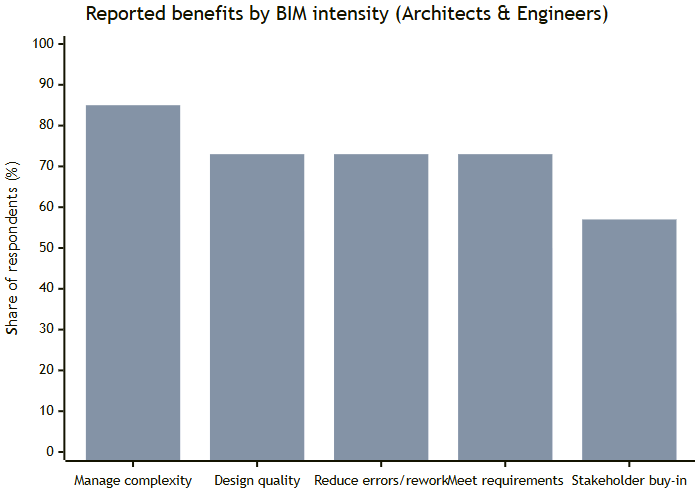
Data source: SmartMarket Report chart on “Impact of BIM intensity on top five BIM benefits for architects and engineers.” [24]
Mitigation strategies and best practices
A defensible response to the hypothesis is not “avoid Revit,” but design the workflow so conceptual exploration is protected while BIM value is preserved.
Use a “representation ecology,” not a single tool. The best-supported model from both cognition and industry practice is that different representations serve different cognitive tasks: ambiguity for ideation, explicitness for coordination. The evidence base that sketches support idea generation and reinterpretation, while model-centric delivery improves coordination outcomes, implies a hybrid workflow is rational. [41]
Delay irreversible commitments; formalize “levels of intention.” A practical method is to distinguish (a) an early “intent model” (massing, spatial logic, key constraints) from (b) a “delivery model” (typed elements, schedules, coordination). Autodesk’s own documentation on templates, family behaviors, and massing studies shows that Revit can support conceptual massing, but BIM-native elements and schedules depend on category/parameter choices that effectively lock in semantics. [42]
Treat libraries as a design variable, not a neutral convenience. If office families/templates encode past solutions, they can silently drive “sameness.” Mitigation is to curate multiple parallel libraries: a conservative “production” library for coordination and compliance, and a “design exploration” library that supports unusual assemblies and geometric logics—even if it requires custom family authoring. Autodesk documentation emphasizes that categories and parameter sets govern family behavior; this is exactly where design intent can be encoded rather than inherited. [12]
Invest in interoperability as a first-class design capability. Empirical Rhino→Revit workflow research demonstrates that design integrity can be disrupted by data loss and conversion friction, and the recommended response is deliberate best practices and tool-bridging strategies rather than ad-hoc import/export. [43]
Use automation to protect design time. The BIM-creativity survey paper explicitly frames a paradox: BIM can impose early detail demands, but automation can also reduce total design hours and free capacity for creative work. The mitigation strategy is to automate documentation-heavy tasks (tagging, sheet creation, parameter management) so that human attention returns to spatial and conceptual judgment. [44]
Education: teach BIM as design reasoning, not only documentation. The global BIM education update compiled by International Construction Information Society[45] describes broad institutional moves toward BIM curricula, including alignment with ISO 19650 and increasing course offerings—conditions that can easily turn studios into “software compliance labs” unless pedagogy explicitly protects conceptual thinking. [46] Evidence from a structured Revit-based conceptual framework (diagrammatic BIM) suggests that BIM can support ideation if students are taught design logic/diagrammatic reasoning inside the BIM environment, though the study design limitations (small sample, no control group) mean results are suggestive rather than definitive. [47]
Education: keep hand drawing and diagrams “alive” alongside BIM training. Student survey evidence shows that learning motivations are strongly tied to industry requirements and employability, and that students associate CAD/BIM advantages primarily with pre-construction documentation and visualization. This indicates a real risk that training skews toward representational production rather than conceptual inquiry unless curricula explicitly scaffold both. [48]
Practical recommendations distilled
For designers in practice: treat Revit as one part of a pipeline, explicitly protect an ambiguity-rich ideation stage, and reduce coordination/documentation drag through automation and curated content strategies. This aligns with the best-supported mechanisms of constraint (early-detail demand, library gravity, interoperability friction) without giving up BIM’s measurable delivery incentives. [49]
For educators: evaluate students on design reasoning and spatial quality rather than model completeness alone; teach interoperability literacy; and integrate BIM into conceptual design through methods that preserve abstraction (diagrammatic reasoning frameworks) rather than using BIM solely as drafting instruction. [50]
Selected References
Goldschmidt, G. (1991). The dialectics of sketching.
Schön, D. A. (1983). The Reflective Practitioner.